What Happens When AI Learns From Itself?
A few years back, artificial intelligence learned almost entirely from us - our books, our conversations, our images, and our ideas. In many ways, AI was a reflection of human knowledge, shaped by the vast amount of information we created and shared online.
But that is starting to change. Today, AI is beginning to learn not just from humans, but from itself.
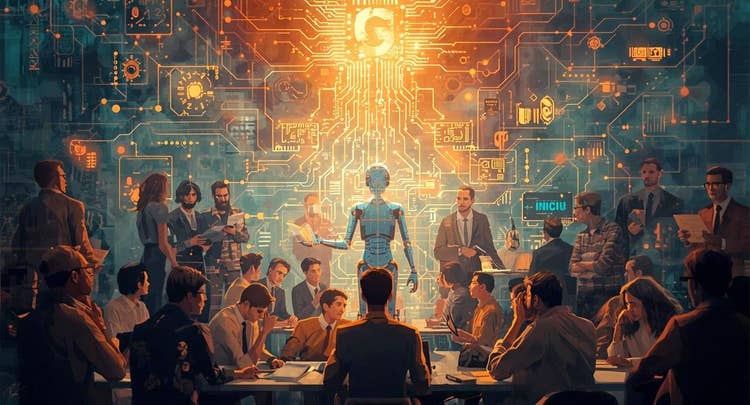
From Human Data to Synthetic Data
Traditionally, training an AI model required enormous amounts of human-generated data. This included everything from articles and books to images and videos. However, there are limits to how much high-quality data exists. Much of the internet has already been used, and new data often comes with challenges such as copyright restrictions, privacy concerns, or low reliability.
To overcome this, researchers and companies have started generating their own data using AI. This is known as synthetic data—information created by AI systems rather than collected from the real world.
For example, one model might produce thousands of text examples, which are then used to train another model. This approach is efficient, scalable, and sometimes even cleaner than real-world data.
Why This Shift Is Happening
There are a few key reasons behind this change.
First, the supply of high-quality human data is limited. While the internet is vast, not all of it is useful or reliable for training AI.
Second, legal and ethical concerns are becoming more important. Issues around copyright and personal data make it harder to freely use human-created content.
As a result, synthetic data offers a practical alternative - it allows developers to create large amounts of training material without relying entirely on external sources.
The Risk: Model Collapse
However, this approach comes with a significant risk.
When AI systems repeatedly learn from data created by other AI systems, small imperfections can begin to accumulate. Errors, biases, or simplifications may be subtly reinforced over time. This phenomenon is sometimes referred to as model collapse.
A simple way to understand this is to imagine making a photocopy of a document. The first copy looks almost identical to the original. But if you copy the copy, and then copy it again, the quality slowly degrades. Details fade, distortions appear, and eventually the result no longer accurately represents the original.
In a similar way, AI trained heavily on synthetic data risks drifting away from the richness and complexity of real human knowledge.
Losing Touch with Reality?
This shift raises a broader and more philosophical question.
If AI begins to rely more on its own generated data, does it slowly drift away from reality? Does it become more “artificial” over time, less connected to the human world it was designed to understand?
AI started as a system that learned from us. But now, it is beginning to build on its own outputs, creating a kind of feedback loop.
Intelligence vs. Grounding
The future of AI may depend not just on how intelligent these systems become, but on how grounded they remain.
Synthetic data can make AI more efficient, scalable, and powerful. But if overused, it risks creating systems that are less accurate, less diverse, and less connected to real-world knowledge.
In the end, the question is no longer just how smart AI can become but whether it will continue to reflect the world around us, or slowly become a reflection of itself.