Unlocking the Speed of Light: How Edge Delivery Services Are Redefining the Web Experience

In today's digital landscape, speed wins. We've grown accustomed to instant gratification with scrolling through Instagram or LinkedIn feeds that snap into place, chatting on WhatsApp where messages appear in milliseconds, or opening emails that load effortlessly. We expect the same seamless, lightning-fast experience from websites. Yet many traditional sites still lag, frustrating users and costing businesses dearly.
Google has prioritized page speed as a ranking factor since 2010, rewarding fast sites with better visibility, lower bounce rates, higher ad viewability, and increased revenue. A delay of just seconds can send visitors bouncing away.
This is where Adobe Edge Delivery Services (EDS), also known as AEM Franklin, shines, consistently delivering perfect Google PageSpeed Insights scores (100/100 across Performance, Accessibility, Best Practices, and SEO on mobile and desktop).

What Does “Delivery at the Edge” Actually Mean?
Key Benefits for Your Business
Blazing-Fast Performance: Faster sites keep visitors engaged longer, boosting conversions and reducing abandonment. Studies show that even a one-second delay can result in a 7% decrease in conversions.
SEO Optimization: Google's algorithms prioritize speed, so EDS helps climb search rankings naturally, driving more organic traffic.
Cost Efficiency: As a cloud-based, serverless solution, it cuts down on infrastructure maintenance while scaling effortlessly for high-traffic spikes.
Flexibility for Teams: Non-technical users can author content easily, while developers appreciate the modular, composable architecture that integrates with tools like SharePoint or Google Drive.
On the technical side (without overwhelming the details), EDS supports headless or hybrid setups, allowing API-driven content pulls (e.g., via GraphQL). It's built on simple HTML, CSS, and vanilla JavaScript, deployed via GitHub for quick iterations.
The real magic? No full rebuilds required. Deployments happen instantly via GitHub. When a developer works on a new feature, they create a branch, and EDS automatically generates a unique preview URL for that branch (typically in the format https://feature-branch--repo--owner.aem.page/). Team members can view, test, and review the changes live without affecting production.
For example: If you're adding a new hero banner on a branch called "new-hero", the test link might be https://new-hero--my-site--mycompany.aem.page/, perfect for quick feedback before merging to main.
Authoring Made Simple with Universal Editor
One of EDS's standout features is its authoring flexibility. Marketers can use the Universal Editor, a WYSIWYG (What You See Is What You Get) tool with live previews to create and edit content intuitively. No coding required; just drag, drop, and publish. For even simpler workflows, content can be authored in familiar tools like Microsoft Word or Google Docs, which EDS automatically converts to web-ready formats.
This democratizes content creation, empowering business teams to update sites in real-time without waiting for IT.

Myths vs. Reality: Busting Common Misconceptions
Myth 1: EDS guarantees a perfect Lighthouse 100 automatically. Reality: EDS makes top scores much easier with a clean foundation, but third-party scripts, consent tools, or heavy analytics can impact performance, just like on any platform.
Myth 2: Edge delivery is just a fancy CDN. Reality: More than caching, EDS is a full workflow with lightweight rendering, optimized assets, and maintainable architecture, served from global edge nodes for near-zero latency.
Myth 3: EDS is only for developers. Reality: The Universal Editor empowers marketers too, intuitive WYSIWYG with live previews, plus authoring in Google Docs or Word for fast, frictionless updates.
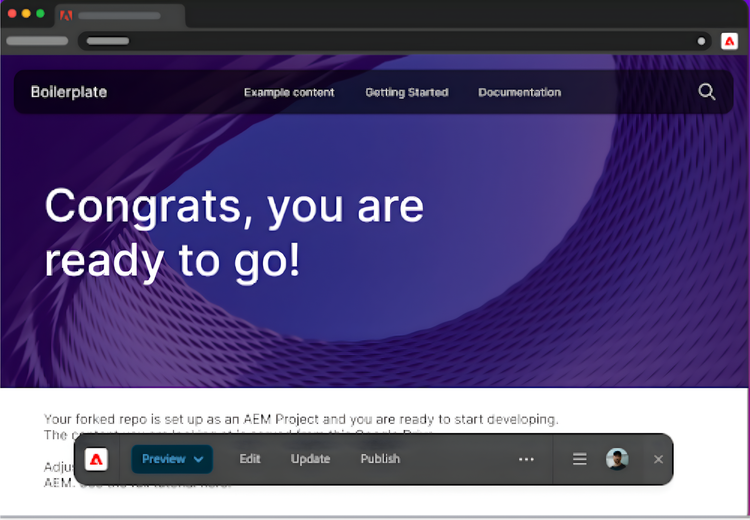
Myth 4: EDS replaces traditional AEM. Reality: It integrates seamlessly within the AEM ecosystem, adding a high-performance delivery option that co-exists with classic practices.
Myth 5: EDS isn't for complex or enterprise sites.Reality: It scales beautifully, co-existing on the same domain as AEM Sites, integrating with Target/Analytics, and handling commerce/personalization for large-scale needs.
Key Benefits for Marketers & Business Owners
App-Like Speed: Keeps users engaged longer, just like TikTok or Instagram, boosting conversions.
SEO Advantage: Higher rankings and more organic traffic.
Easy Content Authoring: Non-technical teams update sites in real-time.
Scalability & Efficiency: Handles spikes effortlessly with lower costs.
Looking Ahead: Adobe's Big Bet on EDS
At eggsunimedia, we're powering our own site with EDS: delivering the instant speed our clients demand.
Ready to make your site load as fast as the apps users love? Reach out for a demo!
You can check the performance on our website here.