Ethical AI at Work: A Practical Framework for Responsible Adoption

Artificial Intelligence is no longer an emerging technology; it has become part of everyday work. Whether we're drafting reports, analyzing data, generating code, preparing presentations, or summarizing meetings, AI is helping us work faster and often more efficiently than ever before. For many organizations, the question is no longer whether AI should be adopted, but how it should be integrated into daily work.
Unfortunately, much of the discussion around AI tends to focus on two extremes. On one side, AI is presented as the solution to every productivity challenge. On the other, it is portrayed as an existential risk that should be approached with fear and hesitation. Neither perspective is particularly helpful.
The real challenge is learning to use AI responsibly, to embrace its capabilities while recognizing its limitations. Ethical AI is not about slowing innovation or avoiding new technologies. It is about ensuring that the way we use AI strengthens our organizations without compromising the rights, dignity, or trust of the people our decisions affect.
Perhaps the most useful question we can ask before using AI is surprisingly simple:
Is AI helping me think better, or is it thinking instead of me?
That distinction matters because AI is an exceptional assistant, but it should never become an unquestioned authority. It excels at removing repetitive work, organizing information, generating first drafts, and helping us explore ideas more quickly. These are precisely the kinds of activities where AI delivers the greatest value, allowing people to dedicate more time to creativity, problem-solving, collaboration, and strategic thinking.
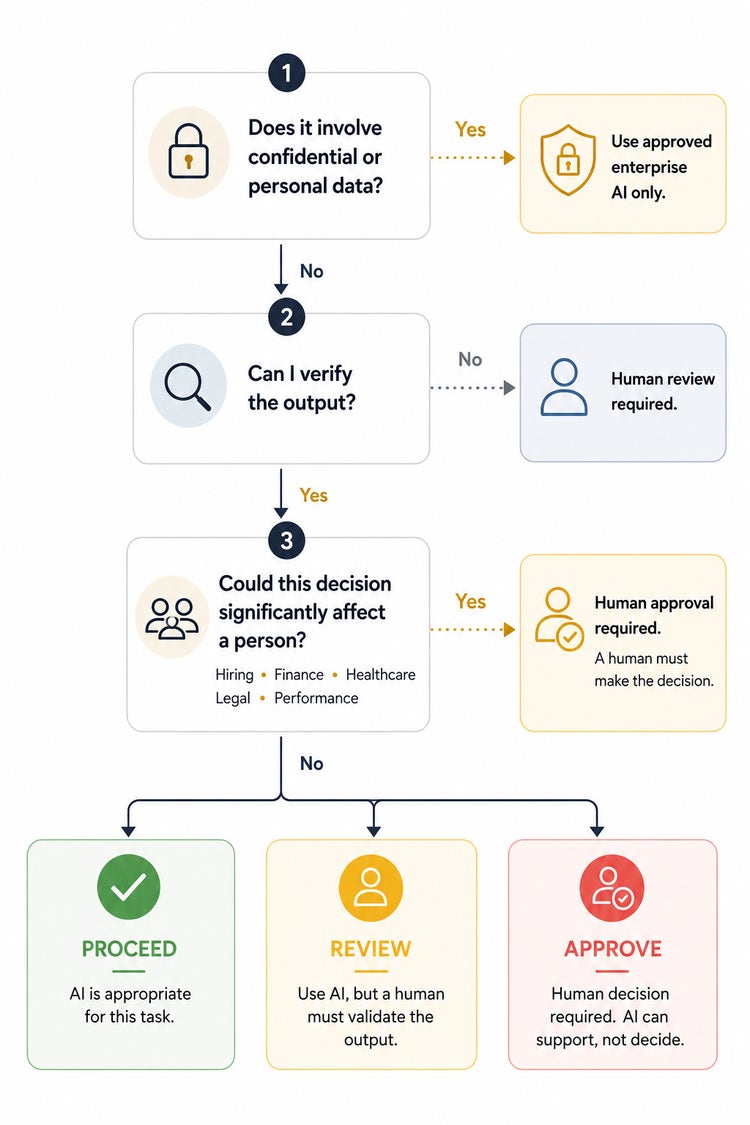
However, not every task should be approached in the same way. The level of trust we place in AI should always be proportional to the impact of the decision being made.
For routine administrative work, such as summarizing meeting notes, improving written communication, translating documents, or generating boilerplate code, AI can often do most of the heavy lifting. Human involvement remains important, but primarily to review and validate the final output.
As the complexity and impact of the work increase, so should human oversight. Research, technical documentation, software development, business analysis, and client proposals can all benefit enormously from AI, but these tasks still require professionals to interpret context, verify information, and exercise sound judgment. AI may identify patterns or suggest solutions, but it cannot understand an organization's culture, customer relationships, or long-term strategic objectives in the way experienced people can.
The highest level of care is required when AI influences decisions that directly affect individuals. Hiring, performance evaluations, financial approvals, legal advice, healthcare, or any process involving confidential information should never rely solely on AI-generated recommendations. In these situations, AI can support the decision-making process, but responsibility must always remain with people. Technology can assist accountability, but it cannot replace it.
This is where discussions about ethics often become abstract. We hear phrases like "responsible AI" or "ethical AI," yet they rarely explain what those ideas actually mean in day-to-day work. In reality, ethical AI begins with respecting fundamental human rights.
Respecting privacy means ensuring that confidential customer, employee, and organizational information is handled appropriately and never shared with AI systems without understanding the associated risks. Respecting fairness means recognizing that AI systems may inherit biases from the data they learn from, making human oversight essential whenever decisions influence people's opportunities or livelihoods. Respecting human agency means ensuring that people retain the ability to question, challenge, and override AI recommendations instead of accepting them uncritically. Finally, accountability requires that every significant decision has a clearly identifiable human owner. If an AI-assisted decision causes harm, responsibility belongs to the organization and the individuals overseeing the process, not to the technology itself.
These principles are not intended to discourage AI adoption. Quite the opposite. They provide a framework that allows organizations to innovate confidently while maintaining the trust of employees, customers, and partners.
A practical way to apply this thinking is to pause before introducing AI into a workflow and ask four questions. Does this use of AI respect people's rights and privacy? Does it support human judgment rather than replace it? Would we be comfortable explaining to those affected how AI contributed to the outcome? And finally, who remains accountable if something goes wrong? If those questions can be answered confidently, AI is likely being used appropriately. If they cannot, the process probably deserves more careful consideration.
Ultimately, the successful adoption of AI is not primarily a technology challenge; it is a leadership challenge. Employees need more than access to powerful tools; they need clear guidance, appropriate training, and a culture that encourages critical thinking rather than blind reliance on automation. Leaders should create environments where AI is viewed as a capable collaborator, not an infallible expert.
The organizations that benefit most from AI will not necessarily be those that automate the most tasks. They will be the ones that understand where automation creates value, where human judgment remains indispensable, and how to balance both responsibly. In doing so, they will build something far more valuable than efficiency alone: trust.
As AI continues to reshape the workplace, perhaps the most important measure of success will not be how much work we have delegated to machines, but whether we have empowered people to do their work more thoughtfully, more creatively, and more ethically than before. Technology may transform the way we work, but trust, accountability, and respect for human dignity will always remain fundamentally human responsibilities.